





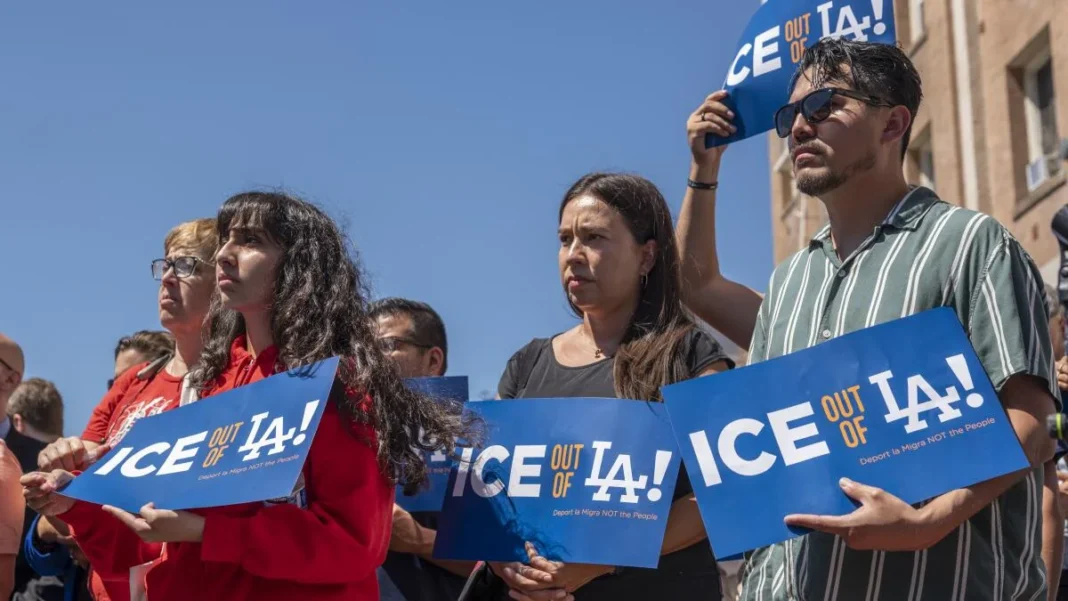
For years, the United States has insisted that its immigration system is governed by law, not impulse. But a series of Supreme Court decisions — some dating back decades, others disturbingly recent — have quietly and systematically rewritten the boundaries of policing in America. The result is a deeply troubling system where Immigration and Customs Enforcement (ICE) can stop, question, and detain individuals with unprecedented ease, operating with virtually unlimited discretion, often without meaningful suspicion and almost entirely without accountability or oversight.
The Court’s latest intervention, allowing ICE to resume broad street‑level stops in Los Angeles, didn’t create this reality. Rather, it starkly revealed the extent to which immigration enforcement has become untethered from constitutional constraints.
A Ruling That Reopened the Door to Profiling

In September 2025, a federal judge in Los Angeles attempted to impose reasonable limits on ICE’s most controversial and constitutionally questionable tactics. Judge Maame Frimpong issued a detailed ruling that barred agents from using race, language, location, or occupation as the primary basis for stops — a direct and necessary response to what she meticulously described as “a mountain of evidence” showing systemic and pervasive constitutional violations throughout the agency’s operations.
The Ninth Circuit Court of Appeals, after careful consideration, largely upheld her carefully crafted restrictions, recognizing the gravity of the constitutional issues at stake.
Then the Supreme Court stepped in, dramatically altering the landscape of immigration enforcement.
With a decisive 6–3 vote that reflected the Court’s ideological divide, the justices suspended the lower court’s carefully reasoned order, effectively allowing ICE to resume the very practices that two levels of the federal judiciary had deemed unconstitutional. Justice Brett Kavanaugh’s majority opinion leaned heavily on a controversial 1996 case, Whren v. United States, which had established the troubling precedent that officers may stop anyone for any technical violation, regardless of their true underlying motive.
In practice, this expansive interpretation means ICE can cite virtually any combination of ordinary factors — speaking Spanish in public, working construction jobs, standing at a bus stop, or simply being present in certain neighborhoods — as constituting “reasonable suspicion” sufficient to justify a stop.
The Court’s message was unmistakable and far-reaching: ICE gets to decide who looks suspicious enough to warrant questioning.
The Human Fallout: Fear, Avoidance, and Wrongful Detentions

The ruling’s impact was immediate and devastating across communities nationwide.
- In Highland Park, a beloved local food vendor suddenly disappeared into ICE custody, leaving behind an empty taco stand and a community of regular customers wondering about his fate.
- In Silver Lake, a 40‑year resident who had spent years collecting recyclables to supplement his income was unceremoniously detained on the sidewalk where he had worked for decades.
- In Downey, two experienced landscapers — one a green‑card holder of 40 years, the other with a valid work permit — were stopped and interrogated until concerned neighbors began filming the encounter.
- In Alabama, a U.S. citizen who was merely documenting an ICE raid was physically restrained, accused of carrying fraudulent identification, and dismissively told his citizenship status “didn’t matter” in the context of the investigation.
These disturbing incidents are not isolated cases or aberrations. They represent the predictable and inevitable outcome of a system deliberately designed to treat entire communities as inherently suspicious, creating a climate of fear and distrust.
The ripple effects extend far beyond the immediate targets of enforcement. More than 14 million U.S. citizens or legal permanent residents live with an undocumented family member, and 6 million children are directly affected by the constant threat of family separation. The Court’s ruling didn’t just expand ICE’s theoretical reach — it dramatically expanded the radius of fear and anxiety around every household with any connection to immigration, creating a chilling effect on daily life and community participation.
The Constitutional Crisis the Court Pretends Doesn’t Exist

Legal scholars have been sounding urgent alarms for decades about the dangerous precedent set by Whren, warning that its expansive interpretation has created a constitutional loophole so vast it threatens to completely undermine the Fourth Amendment’s core protections. The Supreme Court’s decision rested on a series of optimistic assumptions that have proven devastatingly wrong in practice: that law enforcement officers would exercise their expanded discretion with appropriate restraint and professional judgment; that instances of abuse would be rare exceptions rather than systemic patterns; and that existing legal frameworks would be sufficient to prevent and address racial profiling concerns.
Time and extensive documentation have thoroughly demolished these assumptions, revealing them as dangerously naive at best and willfully blind at worst.
The Fourth Amendment
- ICE’s enforcement practices rely almost exclusively on administrative warrants that bypass judicial oversight, rather than obtaining proper judicial warrants that would require demonstrating probable cause to a neutral magistrate. This effectively circumvents the Fourth Amendment’s warrant requirement.
- Agents routinely justify stops based on vague “suspicious profiles” that amount to little more than stereotypes and hunches, rather than the specific, articulable facts that the Constitution demands. These profiles often incorporate factors like speaking Spanish, shopping at certain stores, or working in particular industries.
- Multiple federal courts have documented widespread, systemic Fourth Amendment violations in ICE operations, revealing patterns that go far beyond isolated mistakes or individual misconduct. These findings demonstrate institutional disregard for constitutional constraints.
The Fourteenth Amendment
- The practical reality of modern immigration enforcement has transformed characteristics like race, primary language, and occupation into de facto proxies for reasonable suspicion, rendering the Fourteenth Amendment’s guarantee of equal protection increasingly theoretical rather than practical. Communities find themselves targeted not for specific suspicious behavior, but for their fundamental characteristics.
- Justice Sonia Sotomayor’s prescient warning cuts to the heart of the constitutional crisis: by accepting these enforcement patterns, the Court has effectively declared that millions of Latino Americans working in certain industries or living in certain neighborhoods exist in a state of perpetual suspicion, fundamentally undermining their right to equal protection under the law.
The Court’s majority has consistently dismissed these profound constitutional concerns with cursory analysis, but the mounting evidence of systemic abuse and discriminatory impact tells a very different story.
The Missing Piece: The Supreme Court Has Also Made ICE Nearly Untouchable

While the dramatic expansion of ICE’s enforcement authority represents a serious threat to constitutional rights, it represents only half of the current crisis. Equally concerning is the Court’s systematic dismantling of virtually every meaningful accountability mechanism that once served to check federal officer misconduct and protect individual rights.
Egbert v. Boule: The Case That Closed the Courthouse Doors
The Supreme Court’s 2022 decision in Egbert v. Boule stands as one of the most consequential rulings in modern law enforcement history, fundamentally reshaping the landscape of federal officer accountability.
The 6-3 decision effectively closed the courthouse doors to most civil rights claims against federal officers, with the Court explicitly acknowledging that it had made such lawsuits “nearly impossible” to pursue successfully. In a striking moment of candor, Justice Neil Gorsuch openly admitted that the Court’s “real message” extended far beyond the specific facts before them.
That broader message was unambiguous and deeply troubling:
Border Patrol and ICE agents now operate with virtually complete immunity from civil liability for constitutional violations.
A Century of Enforcement, Zero Accountability
The statistical evidence of this accountability crisis is both clear and deeply disturbing:
- In the nearly 100-year history of the Border Patrol, not a single agent has ever been successfully prosecuted for using lethal or excessive force in the line of duty.
- The ACLU’s comprehensive documentation reveals 218 deaths resulting from CBP encounters between 2010 and 2022 alone, none of which resulted in meaningful accountability.
- Undocumented individuals who survive rights violations rarely pursue legal remedies, knowing that seeking justice could expose them to deportation.
- A majority of legal advocates (52%) report having clients abandon valid legal claims specifically because they fear ICE retaliation.
This isn’t merely a system that occasionally fails to address abuses – it’s a system deliberately structured to ensure that even the most egregious violations face no meaningful consequences.
The Court insists that officers can be trusted with this extraordinary power, maintaining an almost unwavering faith in the judgment and professionalism of federal agents. However, the lived reality—from Los Angeles to Alabama and countless communities in between—demonstrates that this trust is gravely misplaced. Documented incidents of misconduct, racial profiling, and constitutional violations paint a stark picture of systemic abuse rather than isolated incidents.
The Question Now Isn’t What ICE Will Do — It’s What the Courts Will Allow
The Supreme Court has systematically constructed a legal framework where ICE wields nearly unlimited authority to stop, question, and detain almost anyone, while facing virtually no meaningful oversight or accountability for their actions.
The country is now living with the devastating results.