


Today’s war-driven displacement across Gaza, Sudan, and Ukraine stands as one of the biggest humanitarian crises we’ve seen. Sudan’s situation is particularly dire. By August 2025, it became the world’s largest displacement crisis with over 12 million people forced to leave their homes. The numbers tell a heartbreaking story – 7.7 million people displaced within Sudan and 4.3 million seeking refuge in nearby countries. One in three Sudanese had to abandon their homes, with 14.3 million people still displaced when 2024 ended.
Sudan’s catastrophe doesn’t stand alone. The combined effect of conflicts in Sudan, Gaza, and Ukraine has changed how people move across borders worldwide. Sudanese communities have kept stronger connections to their homeland than most other immigrant groups. Ukrainian and Palestinian refugees show similar patterns. Children under 18 make up more than half (51 percent) of Sudan’s internally displaced people. These three conflicts have created new ways for people to connect and support each other across national boundaries.
The size of this crisis defies imagination. Sudan’s war has forced more than eight million people from their homes in Khartoum, Darfur, and central Sudan. These numbers exceed those in Gaza and come close to Ukraine’s longer-running conflict. Global displacement showed a tiny ray of hope with a 1 percent drop to 122.1 million by April 2025 – the first decrease in over ten years. Yet Sudan’s internal crisis remains unmatched in recorded history, with about 11.6 million people displaced within its borders by late 2024.
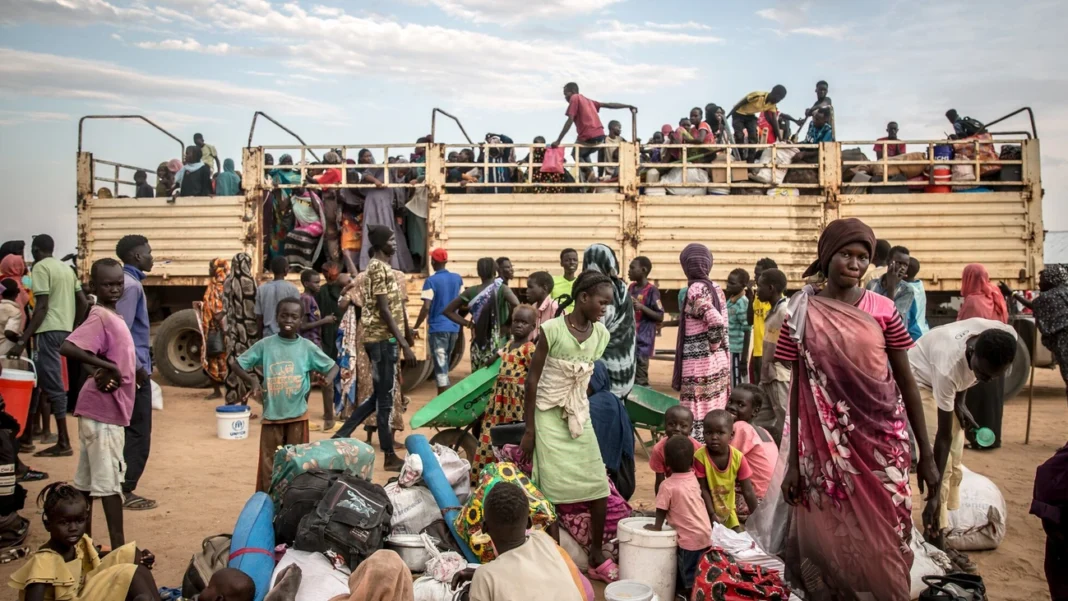
Wars Displace Millions Across Sudan, Gaza and Ukraine

Image Source: NPR
Modern warfare has created massive waves of forced migration that reshape demographics worldwide. The ongoing conflicts in Sudan, Gaza, and Ukraine show how civilians bear the brunt of these wars.
Sudan people flee amid RSF and SAF conflict
The battle between the Sudanese Armed Forces (SAF) and the Rapid Support Forces (RSF) started on April 15, 2023, and created the world’s biggest displacement crisis. Nearly 15 million people have left their homes within and outside Sudan’s borders since mid-2023. This number represents almost one-third of Sudan’s total population.
Sudan had about 15% of all internally displaced persons worldwide at the peak of this crisis. This meant one in every seven IDPs globally was Sudanese. Right now, about 9.33 million people remain displaced inside the country. The crisis hits children hardest – they make up 55% of all internally displaced Sudanese.
The fighting continues unabated. Over 100,000 people fled their homes in Al Fasher, North Darfur due to increased violence in late October 2025. Recent clashes in Kordofan pushed another 65,000 people from their homes. Many Sudanese have escaped to nearby countries, with Egypt now sheltering the largest number – 1.5 million refugees.
Gaza civilians trapped in generational siege
Gaza faces what could be the most concentrated displacement crisis in the world. Almost 19 out of every 20 Palestinians in Gaza had to leave their homes at least once by the end of 2024. Most had to move multiple times. About 1.9 million people out of Gaza’s 2.2 million residents were displaced as of October 2024.
The human cost goes deeper than numbers. Gaza has more child amputees per capita than anywhere else in the world. A nutrition crisis has emerged – acute malnutrition among children under five jumped from 2.4% in February to 9% by mid-2025. The UN Relief and Works Agency reports that one in five children in Gaza city doesn’t get enough food.
People move in massive numbers – up to 20,000 head south in a single day. Over 320,000 residents have left Gaza’s largest city since mid-August. This constant movement makes it hard to deliver humanitarian aid.
Ukraine’s war triggers Europe’s largest refugee crisis since WWII
Russia’s invasion of Ukraine created the biggest refugee crisis Europe has seen since World War II. UNHCR data shows 5.7 million Ukrainian refugees worldwide as of September 2025, with 90% living in European countries.
The refugee population tells a striking story – about 90% are women and children. Ukrainian martial law keeps most men between 18-60 years from leaving the country. This creates unique challenges for host countries and refugee communities.
The pattern of refugee movement has changed since 2022. While Poland saw the highest numbers early on, Germany now hosts 1.3 million Ukrainian refugees. The Czech Republic stands out – Ukrainian refugees make up nearly 4% of its total population, the highest proportion in the EU.
The European Union stepped up by activating a temporary protection mechanism in March 2022, which now runs until 2027. This gives Ukrainians the right to live, work, and access social benefits in EU countries. The EU has set aside about €17 billion to help host countries manage this crisis.
Diaspora Communities Step In Where States Fail

Image Source: El Pais in English – EL PAÍS
Diaspora communities have become vital lifelines for civilians trapped in war zones while state institutions struggle during conflicts. Communities from Gaza, Sudan, and Ukraine use their unique position to help where traditional aid can’t reach.
Sudanese diaspora funds soup kitchens and clinics
The Sudanese diaspora has rallied remarkable support since fighting broke out on April 15, 2023. Banking apps went down and many banks were destroyed. Diaspora members quickly adapted and used alternative support methods. They shared advice and information on social media to help families find food, shelter, and evacuation routes.
Diaspora professionals fill essential gaps in humanitarian response through grassroots initiatives like Emergency Response Rooms. These efforts work across humanitarian, development, and peacebuilding areas without the strict mandates that limit institutional aid organizations. SOAS President Zeinab Badawi launched Humanitarian Action for Sudan (HAS) in June 2023. This initiative brings together experienced professionals from the Sudanese diaspora who send direct cash transfers to emergency responders in Sudan.
Ukrainian diaspora lobbies for military and humanitarian aid
Ukraine’s estimated 20 million diaspora members worldwide have played a vital role in supporting their homeland since Russia’s 2022 invasion. Their support network grew stronger after Russia annexed Crimea in 2014. This prepared them to respond faster when full-scale war began.
Support has become harder to maintain. A UK-based diaspora activist said: “Two years ago, I was able to raise £10,000 in just five days. Now, after three weeks of fundraising I’ve only managed to raise £3,000”. Financial remittances dropped from U.S. $66.09 billion in 2021 to U.S. $55.08 billion in 2023 through formal channels. The National Bank of Ukraine linked this decline to diaspora members hosting relatives who fled the war.
Palestinian diaspora supports education and relief in Gaza
Palestinian diaspora organizations worldwide have stepped up their efforts to address Gaza’s growing humanitarian crisis. A recent study found 81 Palestinian diaspora organizations providing essential support to affected families. These organizations work in many sectors, with over 70% focusing on advocacy work.
The Abdulla Al Ghurair Foundation created a relief fund that helps 900 Palestinian students from Gaza and the West Bank complete their university education outside Palestine. Students focus on medicine, health sciences, and STEM fields. The program covers tuition fees, living expenses, and other costs.
Malala Fund has committed AED 367,194.04 to The International Network for Aid, Relief, and Assistance (INARA) to provide education and psychosocial support to vulnerable children. This partnership will give out 1,400 educational kits and strengthen 10 temporary learning spaces in Gaza. It will also offer mental health support through group sessions for 480 children and promote literacy through five adolescent reading initiatives.
Youth Lead Grassroots Humanitarian Networks

Image Source: The New Humanitarian
Young people have become vital humanitarian leaders in conflict zones. They create innovative grassroots networks that meet critical needs where formal institutions fall short. Their initiatives showcase a new model of community-driven response that exceeds traditional aid systems.
Emergency Response Rooms in Sudan fill aid gaps
Youth-driven Emergency Response Rooms (ERRs) now form the backbone of Sudan’s humanitarian response. These grassroots networks operate in all 18 states and have helped more than four million civilians. They bypass bureaucracy and implement groundbreaking solutions. Hanin Ahmed, a young Sudanese activist, started an emergency room in Omdurman with a colleague after war broke out in April 2023. They stepped in when international organizations left. AbuZar Othman, Darfur emergency rooms coordinator, describes these initiatives as a “local emergency government”.
ERRs have moved approximately 12,000 people from dangerous areas. This includes more than 800 evacuations from Al-Fitaihab in Omdurman during December 2023. Local volunteers provide food, electricity, water, and protection services. These ERRs grew from resistance committees that led protests against Omar al-Bashir’s regime in 2019. They build on Sudan’s tradition of “nafeer”—where communities pool resources to help those in need.
Ukrainian youth organize digital resistance and aid
Ukrainian young people have built sophisticated digital platforms that connect humanitarian needs with resources. Youth quickly set up volunteer networks through apps like Telegram to coordinate evacuations and shelter after Russia invaded. Sofia, an economics student from Bucha studying in France, worked with classmates to launch “Hear Ukraine.” Their Instagram page shares infographics and interviews that show how war affects civilian lives.
Ukraine’s Ministry of Digital Transformation supported the creation of eDopomoga platform. This system effectively manages humanitarian aid collection and distribution by connecting government resources, businesses, and volunteers. Many young Ukrainians now serve in the armed forces while others volunteer through digital platforms like SpivDiia.
Gazan youth document war and provide peer support
Young people in Gaza lead significant mental health and psychosocial support efforts during ongoing trauma. The Youth MHPSS Network started with 25 volunteers trained in emotional processing and stress management. They have reached 814 displaced youth through peer-to-peer support sessions. Janna Barakat, a 20-year-old from Gaza, learned vital lessons and became a trainer herself. She delivered four sessions to peers in camp settings.
Ali Jibreel, a young man with a physical disability, discovered new purpose through UNESCO’s peer-to-peer training program. “The Youth for Hope project gave me a reason to wake up in the morning and leave the atmosphere of the camp to participate in something meaningful,” Ali shared. Youth-led projects in Gaza also document the war’s social impacts through research papers and analytical work.
These youth-led initiatives show how young people in conflict zones have evolved from aid recipients to innovative humanitarian leaders. They create effective response systems where traditional mechanisms have failed.
How Modern Diaspora Redefines National Identity
Diaspora communities from Gaza, Sudan, and Ukraine are creating new forms of belonging that go beyond geographical borders. These communities blend resistance, civic action, and cultural preservation to redefine their national identity.
Diaspora as both refuge and resistance
Diasporic identity represents both sanctuary and political action. Palestinians demonstrate this dual nature by using internationalist norms to ask for political rights. They resist being labeled as just humanitarian cases. Refugee camps started as developmentalist villages and changed into significant spaces. These spaces help preserve cultural practices, village geographies, and political self-definition. These communities actively shape the global refugee regime rather than just receiving aid.
Civic engagement from abroad shapes homeland politics
Activities developed in receiving countries that focus on homelands reshape national politics fundamentally. Studies show that migrants’ experiences in hometown associations maintain civic ties with their origin countries. These experiences also enhance their civic action in host nations. The Armenian Diaspora shows this pattern well, especially through their lobbying work. Their efforts to gain recognition for the 1915 events have become central to their diasporic identity. Diaspora communities’ international positions make them influential in foreign policy.
Cultural preservation through language, art, and education
Communities think over ways to keep their cultural identity alive. Pacific diaspora groups preserve their heritage through language, traditional music, dance, food, and religious practices. Host countries and countries of origin support these preservation efforts. New Zealand’s Ministry for Pacific Peoples promotes Pacific language weeks. Fiji developed the iVolavosa App to help its diaspora learn iTaukei. Diaspora organizations create spaces for cultural events, language classes, and community gatherings that strengthen identity. These activities ensure cultural legacies continue despite physical distance.
What Does a ‘Diaspora Century’ Mean for the World?
Mass population movements define our twenty-first century world. These shifts carry deep implications for global governance and international relations.
Global displacement trends reshape demographics
The world faces an unprecedented migration crisis. Today, 123.2 million people live as forcibly displaced individuals—representing 1 in every 67 humans on Earth. Early 2025 brought a slight ray of hope with a 1% decrease in global displacement figures, marking the first reduction in over a decade. Yet the bigger picture remains concerning since displacement numbers have nearly doubled in the last ten years. Migration extends beyond forced movement. The world now counts 281 million international migrants. These people create vibrant transnational communities that span continents.
Diaspora diplomacy emerges as a new force
Diaspora communities now serve as powerful extensions of their home nations’ influence. Many countries make use of their overseas populations as diplomatic assets. This has given rise to what experts call “diasporic geopolitics”—where states exercise power across national boundaries. Rising global powers especially head over to their diaspora communities for more than just cultural promotion. To cite an instance, India’s diaspora contributed AED 495.71 billion in remittances during 2024-2025. This highlights the economic strength of these relationships.
Challenges of integration vs. transnational loyalty
Modern research contradicts old beliefs about integration weakening ties to home countries. Studies reveal that stable jobs in host countries help migrants send more money home and maintain stronger connections with their roots. Questions about split loyalties continue. Populist rhetoric often amplifies these concerns. Evidence shows most migrants know how to balance their multiple cultural identities successfully.
Global migration patterns have changed dramatically due to displacement crises in Gaza, Sudan, and Ukraine. Scholars now view this era as a new “diaspora century.” These conflicts have forced tens of millions to flee their homes, and children have suffered the heaviest impact. The year 2025 showed the first slight decrease in global displacement figures in over a decade. However, the situation remains concerning since forced migration has nearly doubled in the last ten years.
Diaspora communities show remarkable strength in their crisis response. They maintain their cultural identities while building innovative support networks that work better than traditional aid systems. Young leaders have proven exceptional at organizing grassroots humanitarian efforts when formal institutions fall short. Emergency Response Rooms in Sudan, digital resistance platforms in Ukraine, and peer support networks in Gaza illustrate this generational shift from aid recipients to humanitarian actors.
These massive population movements have redefined national identity itself. Diaspora communities now serve as both safe havens and resistance centers. They stay civically engaged with their homelands while adapting to their host societies. Their identities continue through language, art, and education despite geographical separation.
Nations have adapted to this reality through “diaspora diplomacy” by treating overseas populations as extensions of their influence. The economic aspect remains vital as remittances continue flowing back to conflict zones, even with disrupted banking systems and destroyed financial infrastructure.
Future generations will see these transnational identities develop further as conflicts continue and displacement becomes normal. Complex forms of belonging that surpass borders are replacing the traditional view of territory-bound nation-states. Without doubt, mass displacement’s humanitarian challenges need innovative solutions for both immediate needs and long-term integration.
The “diaspora century” represents more than just a crisis – it fundamentally changes our understanding of community, nationality, and human movement. These displaced populations, particularly children, will influence international politics, cultural exchange, and humanitarian response for decades. Their experiences, though rooted in tragedy, ended up creating more resilient and adaptable social structures ready for future conflicts.